
 Act 1Above the surfacePlay the act →
Home / Follow the story / Act 3, scene 14: Governing the invariants
Act 3, scene 14: Governing the invariants
Transcript
Scene 14: Governing the invariants
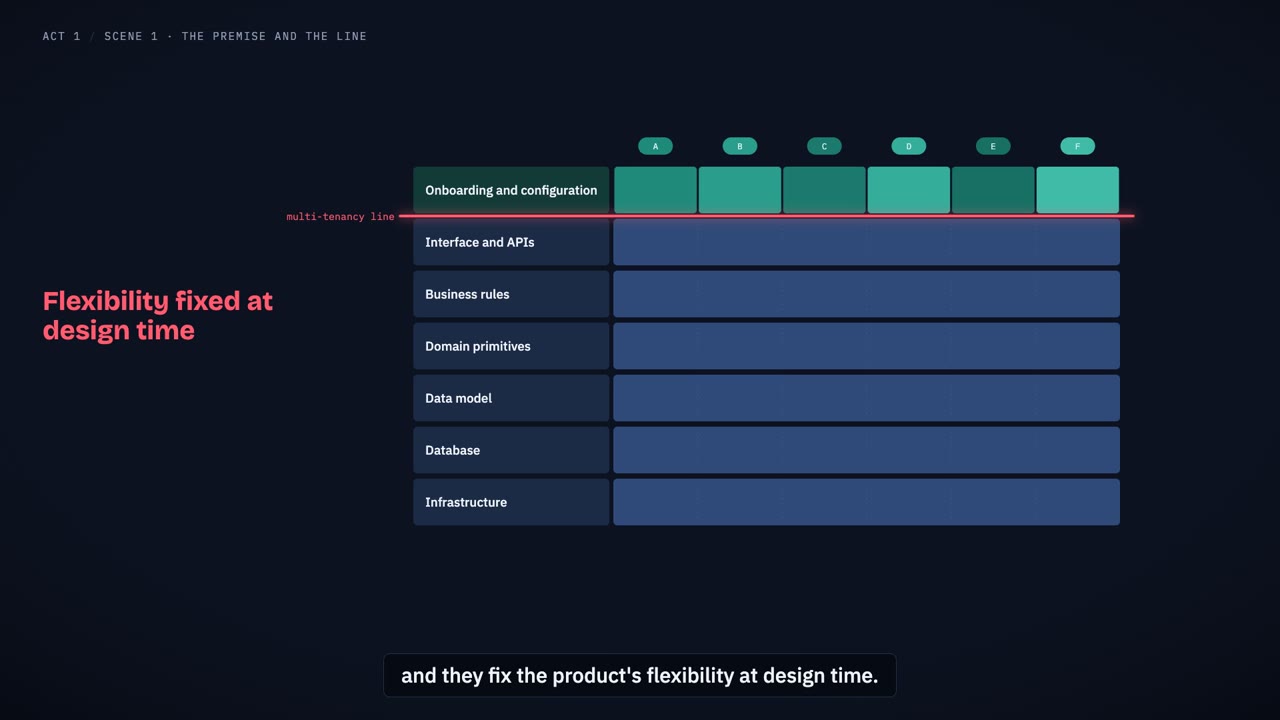
The invariants below the line change as well, far less often and with far more at stake, because every tenant stands on them. Semantic engineering governs changes to the invariants. The knowledge graph records the application in four linked layers: what it does, how it looks and behaves, how it is organised, and how it is built. Each layer has a named custodian, a person accountable for its accuracy. When an invariant needs to change, agents traverse the graph to find everything the change touches, across every layer, and report the impact before any code is written. Generation agents then work only against what the graph declares, validation agents check the result against the graph, and the change merges only when those checks pass. The graph is updated on every merge, so it stays current. Above the line, the language bounds what each customer can change. Below it, the graph governs what the product can change. Semantic engineering governs the invariants below the line. Dialect engineering governs each customer's language above it.
Go deeper
The full video in five acts, one act at a time.


