
 Act 1Above the surfacePlay the act →
SaaS architecture when code is cheap: an explainer video and guide to the paper
How to use this site
- Play the overview. It sets Dialect Engineering beside Semantic Engineering, then covers the whole argument in about two and a half minutes.
- Go deeper. Below the video, follow the story act by act, pick a layer to see it before and after, or build a short explanation for your own product. Each part pauses at its end with the sections of the paper it drew on.
- Follow the highlights. Beside the video, or below it on a phone, the highlights show the sections the current scene draws on. Select one to pause and read it.
- Explore a frame. Pause, then select Explore to outline what you can click in the picture. Sections lists every part of the paper.
Transcript
Overview
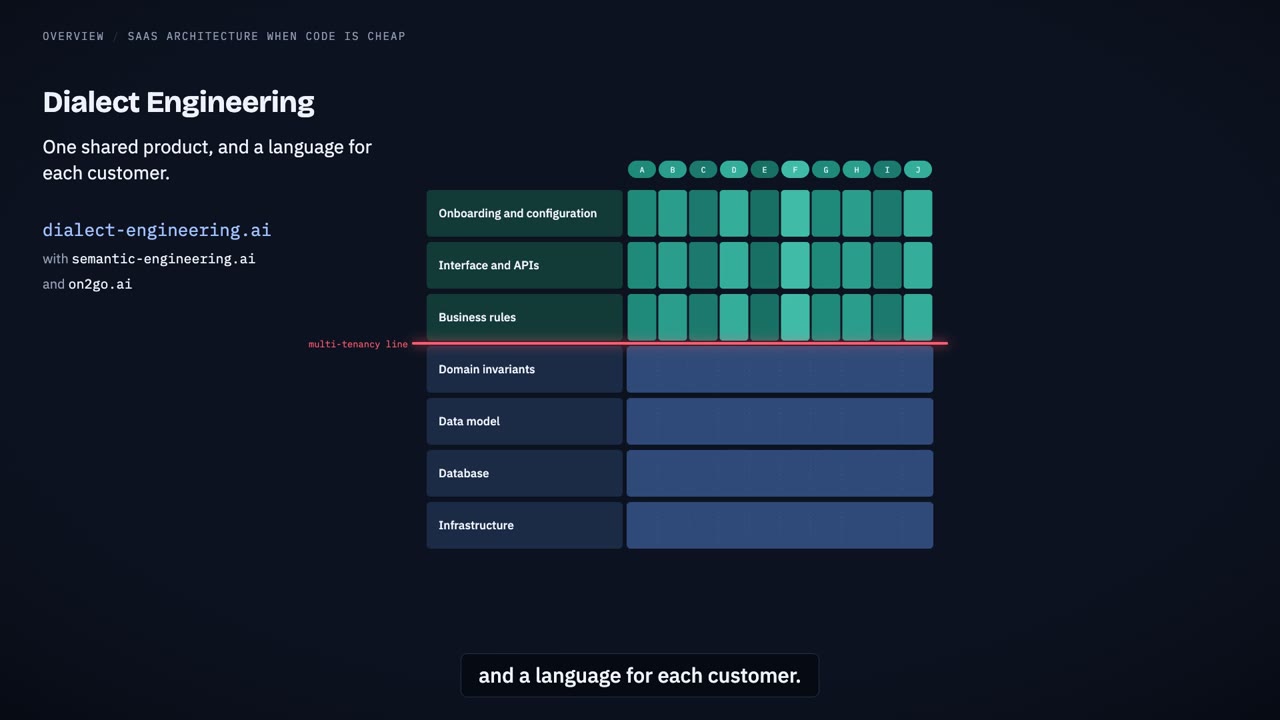
When code becomes cheap, a software product can change in two places. Below the water, the product stays as it is, and building and changing it becomes faster and safer: that is Semantic Engineering. Above the water, the product itself changes shape, so each customer's needs are written in a language over what every customer shares: that is Dialect Engineering. Both stand on one foundation: a knowledge graph of what the product is. Dialect Engineering is the part above the water. SaaS architecture rests on one premise: writing the code is the expensive part. So products share every layer they can, and draw the line between shared and per-customer as high as it will go. When a customer needs something the configuration did not anticipate, the quick answer is a special case in shared code, and every tenant carries it. Coding agents are now reported building whole applications end to end. If code is no longer the expensive part, the line can move. Customers want to start without a project measured in months, change things easily after go-live, personalise down to the individual user, and have their own agents operate the product. Beneath every customer's variation sit the domain invariants: the entities, calculations and relationships every customer shares. The product's knowledge graph already records them. Put a language on top of them. The invariants are its vocabulary, and its grammar says how each customer's business rules may combine them. The line moves down to sit on the invariants. An agent writes each customer's rules in that language from what the customer asks for, and a validator, tests and a compiler check them before anything reaches the product. An existing product can start at the top, with onboarding, which leaves the product's code untouched. That is Dialect Engineering: one shared product, and a language for each customer. Each part of the full video goes deeper, with the paper's sources.
Want it for your own product? Build a short explanation from three choices.
Go deeper
The full video in five acts, one act at a time.


Below and Above the Water
When code becomes cheap, a software product can change in two places. Below the water, the product stays as it is, and building and changing it becomes faster and safer: that is Semantic Engineering. Above the water, the product itself changes shape, so each customer's needs are written in a language over what every customer shares: that is Dialect Engineering. Both stand on one foundation: a knowledge graph of what the product is.
Dialect Engineering is the part above the water, and the subject of this site and its paper. It moves the line between what every customer shares and what each customer gets down onto the domain invariants, and writes each customer's variation as a document in a language over them.
The knowledge graph is the bridge between the two. Semantic Engineering extracts it from the product: its capabilities, workflows and entities. That graph is the canonical model the language is built on, read from the product itself, without designing a company-wide model from scratch.
Which do you need?
- The product stays as it is, and you want building and changing it to be faster and safer: Semantic Engineering, at semantic-engineering.ai.
- The product has to vary per customer: both, starting with the graph. Semantic Engineering builds it from your product, and Dialect Engineering builds the language on it.