
Customers increasingly expect three things at once: use without a long implementation, easy change after go-live, and personalisation below the tenant, down to the individual user. They also increasingly expect their own agents to operate the product, which needs a formal description of what the domain can be asked to do.
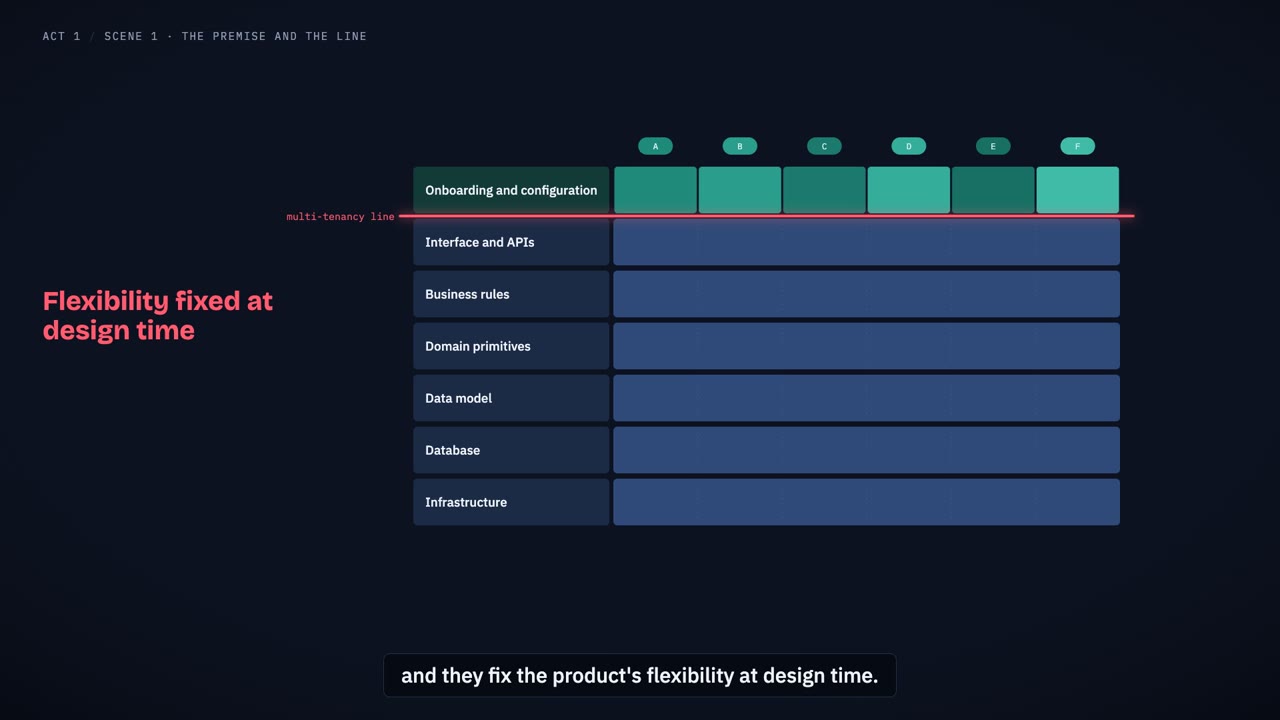
Three requirements are arriving together, and a high line makes all three hard.
Immediate use. A customer expects to start using software without a project. Long onboarding is tolerated in enterprise B2B because there has been no alternative. Enterprise implementation is still measured in months: the 2026 ERP Report found a median project timeline of nine months, with almost a quarter of organisations over schedule (The 2026 ERP Report, Panorama Consulting Group). In Gartner's 2023 software buying survey of 3,484 buyers, slow or complex implementation was the second most cited reason for regretting a purchase, at 32% (TechRepublic reporting Gartner Digital Markets, 2023).
Easy change. After go-live, a change to how the product behaves for one customer should be a small, contained action. Where the line is high, such a change is either a configuration value the mechanism happens to expose, or an engineering change to a shared layer. There is no middle option.
Personalisation below the tenant. Configuration granularity currently stops at the tenant, and the demand is moving to the individual user. Gartner predicts that by 2028 more than 20% of digital workplace applications will use AI-driven personalisation to adapt to the individual worker, and reports that only 23% of digital workers were completely satisfied with their work applications in 2024 (Gartner, March 2025). This is an architectural change, and what drives it is agents.
Software is acquiring the expectation that it can be operated by the user's own agent. Gartner predicts that 33% of enterprise software applications will include agentic AI by 2028, up from less than 1% in 2024, while also predicting that over 40% of agentic AI projects will be cancelled by the end of 2027 (Gartner, June 2025). It also predicts that by 2028 a third of user experiences will shift from native applications to agentic front ends (Gartner, August 2025). Once the expectation settles, a B2B buyer asks whether your product can be driven by their agent, and treats a product that requires a person to click through menus as a product with an integration gap. The timing is uncertain while the direction is settled, and a company with no answer prepared will be answering it under pressure.
Many platforms already offer APIs, which let a program bypass the screens: operations go through the same service the application itself uses (Use the Microsoft Dataverse Web API, Microsoft Learn, 2026). An API exposes operations, though, and an agent using it still has to learn elsewhere which combinations of them are valid.
Agent addressability reaches below the surface, which is what ties it back to the line. An agent needs to know what the product can be asked to do, in terms the domain uses, with the rules that govern valid combinations. That is the same artefact a lower multi-tenancy line requires: a formal description of the product's domain capability, the value proposition of section 1.3, in place of a set of forms and a configuration schema.